
I bought my first portable solar panels three summers ago, right before a two week van trip, and I still remember standing in a parking lot trying to figure out why my phone wasn’t charging. That mistake taught me more than any spec sheet ever did, and it’s why I wanted to write this guide the way I wish someone had explained it to me back then.
What Are Portable Solar Panels?
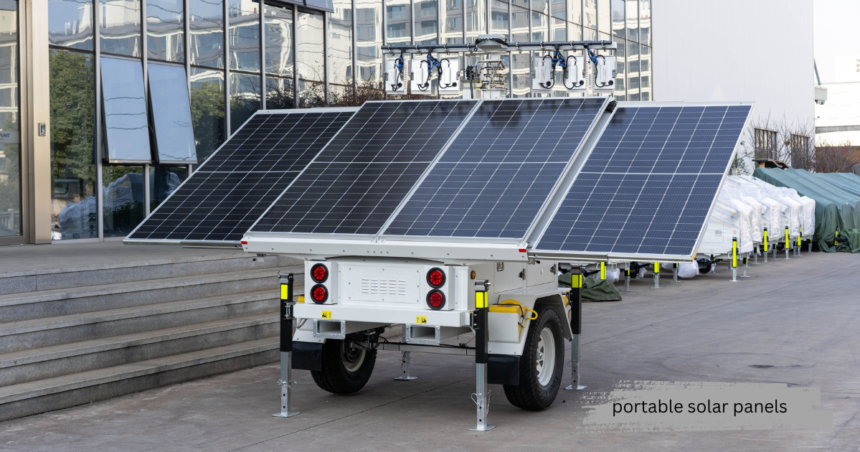
Portable solar panels are the travel sized cousin of the panels bolted to a roof plugin panels you can carry, not mounted units you install once. They can’t power an entire home, but they’ll happily charge phones, laptops, and small appliances, and will even respond weakly to artificial light indoors.
Types of Portable Solar Panels
There are two families flexible solar panels, which are lightweight, thinner, and bend up to 30 degrees, and rigid foldable panels, which don’t flex but fold up for easier storage. Just like fixed solar panels, portable ones still work on cloudy days since light still reaches them as filtered sunlight, though direct sunlight always produces more electricity.
How Portable Solar Panels Deliver Power
You usually can’t plug a device straight into the panel you need a solar inverter to convert the direct current (DC) the panel makes into alternating current (AC), which is what electrical devices run on. For power after dark, add a portable solar battery and a charge controller to prevent overcharging.
Build Quality and Durability
On build quality a 415 watt bifacial panel from Sirius PV runs about $195, while a 400 watt portable panel from Anker Sole is close to $900 a $700 price gap. Rigid panels use aluminum housing, tempered glass, and EVA encapsulation for durability, while foldable panels rely on laminates and fabrics over hinges that eventually wear out and are more prone to impact cracks, especially since a 400W panel is really four 100W panels wired together, so damaging one section costs real output.
How a Solar Cell Works Inside
Inside, a solar cell works on photovoltaic principles light hits silicon, a photon knocks an electron loose leaving a hole behind, and that’s the photovoltaic effect. A semiconductor layer forms a PN junction between a positive electrode and a negative electrode, with fingers funneling current into a bus bar, all protected under a glass layer since the cells are thin enough to crack without it. Cells are either crystalline (monocrystalline or polycrystalline) or thin film (amorphous silicon), and are wired together into a solar module, string, or array typically 36, 60, 72, or 96 cells per module, depending on the target voltage.
How to Use Them
Position panels facing south at roughly a 30 degree tilt for maximum sunlight. Laid flat, they still work, just less efficiently. Connect them to portable Solar Panels for AC power, and pair a charge controller with a portable solar battery for stored power. Cables and ports usually ship in the box as part of a solar generation kit.
Rigid panel setups stay solid and resist bending or warping. Foldable setups, made of smaller panels strung together, sit closer to the ground, so shading and heat retention hurt their performance more. Rigid mounted panels get better airflow and stay cooler.
Given the cost per watt, two rigid panels usually beat one similarly priced foldable unit for long term energy independence and lifespan.
What Are Portable Solar Panels Used For?
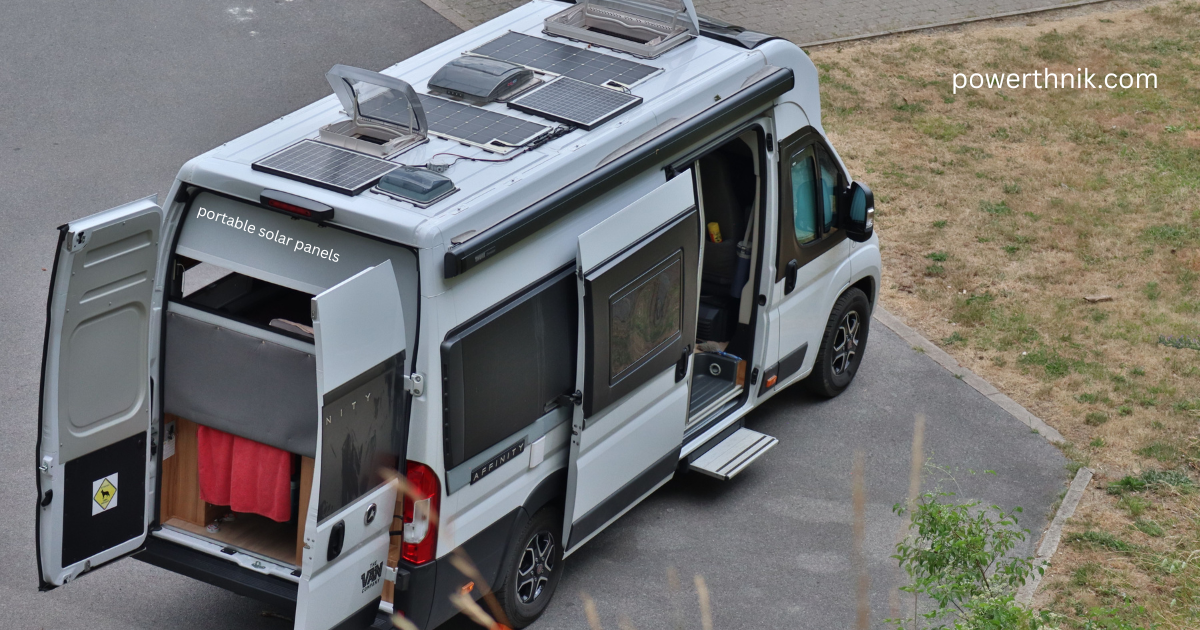
Mainly camping trips, hikes, boat trips, and other outdoor journeys plus running appliances in motorhomes and boats (marine solar panels for boats specifically). You don’t need to be an outdoor fanatic to benefit though; they’re also useful for balconies, gardens, or rented properties where roof installation isn’t possible.
How Much Power Can They Provide?
Output depends on wattage, efficiency rating, and sunlight absorption, and is higher in summer than winter. A 100W panel produces about 0.6 0.7 kWh per day under optimal conditions enough for a couple of phones and a laptop.
Scaling up two 400W panels cost about $1,500 for an 800W array, while ten 415W bifacial panels cost about $2,000 for a 4,000W array much more power for similar money.
Wiring in series adds voltage while current stays the same, so cells at 30 volts and 8 amps give 240 watts; wiring in parallel instead adds current while voltage stays the same. Systems must stay within the charge controller and inverter’s voltage/amp limits, commonly around 100 150 volts and 25 amps. Grid connected systems with a battery bank can use net metering to sell excess power back to the grid.
Conclusion
Portable solar panels aren’t a replacement for a full roof system they solve a simpler problem keeping small devices charged wherever the sun reaches you. The core setup is a panel, an inverter, and optionally a battery with a charge controller.
If you camp, hike, or travel in a van, boat, or RV, foldable panels are worth it. If you want home backup power or the best value per watt, rigid panels usually win. Either way, aim it right, protect it from damage, and it’ll do its job for years.
FAQs
What is a portable solar panel?
A portable solar panel is a lightweight, foldable solar device that converts sunlight into electricity. It’s easy to carry and ideal for camping, travel, or outdoor use.
What wattage do portable solar panels come in?
They typically range from 20W to 200W or more, depending on your power needs.
Do portable solar panels work in cloudy weather?
Yes, but their efficiency decreases. Direct sunlight provides the best output.
What can be charged with a portable solar panel?
Smartphones, laptops, power banks, cameras, and other small electronics. Some high capacity panels can also charge power stations and batteries.
What should I consider before buying a portable solar panel?
Key factors include wattage, efficiency rating, weight, foldability, water resistance, and connector type (USB, DC, MC4).
Are portable solar panels waterproof?
Most quality panels have an IP65 rating or higher, which protects them from light rain, but they aren’t suitable for full submersion.
How long do portable solar panels last?
They generally last 10 to 25 years, depending on build quality and maintenance.
Are portable solar panels easy to use for beginners?
Yes, most come with a plug and play design that requires no technical expertise.