
Solar lights outdoor are one of the easiest upgrades you can make to a UK home this year. Lighting up a garden, driveway, or patio used to mean hiring an electrician and digging trenches for cables but these fixtures charge during the day and switch on automatically once it gets dark, giving you a safer, more attractive outdoor space without touching your electricity bill.
Whether you want a bright flood light for security, a soft glow along a garden path, or fairy lights strung across a patio for summer evenings, there is a solar lights outdoor option built for it.
Why Solar Lights Work So Well in the UK
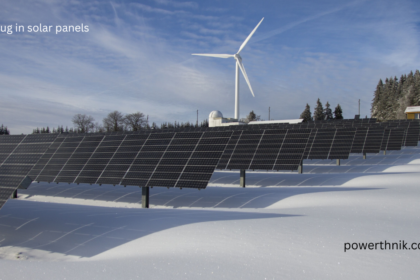
A common worry among UK homeowners is whether solar lights outdoor can really cope with our weather. The good news is that modern solar panels charge from daylight, not just direct sunlight, so they keep working even on overcast days.
Performance does shift with the seasons. Spring and summer bring longer daylight hours and longer runtimes. Autumn and winter mean shorter days and less stored energy by evening. The trick to getting the most out of any unit, whatever the season, is positioning the solar panel somewhere open, away from trees, fences, or buildings that cast shade for most of the day.
Most reputable solar lights outdoor sold in the UK are designed with local conditions in mind, often backed by a two-year warranty and a money-back guarantee a strong sign of how confident manufacturers are in year-round reliability.
Types of Solar Lights Outdoor to Choose From
Before buying anything, it helps to know what’s actually available, because solar lights outdoor covers a huge range of products:
- Solar security lightswith motion sensors, ideal for driveways, entrances, garages, and side access routes.
- Solar fairy lights and string lights, perfect for trees, pergolas, fences, and patios where you want a decorative glow rather than bright illumination.
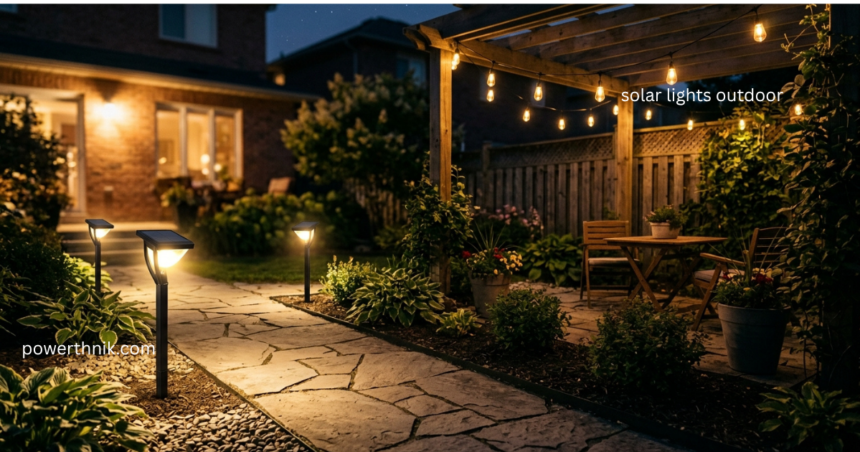
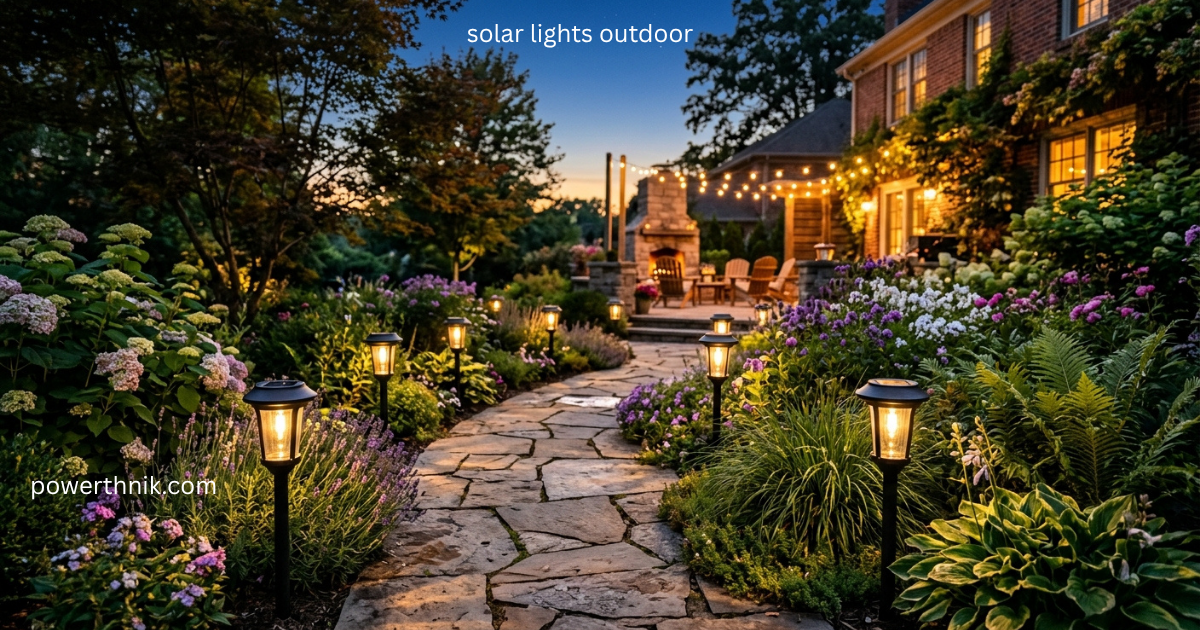
- Solar garden and path lights, designed for flower beds, borders, and walkways so people can move safely after dark.
- Solar fence and wall lights, a popular pick for boundaries, garden perimeters, and front doors.
- Solar decking and step lights, built for stairs and outdoor entertaining areas.
- Solar lanterns, which add a decorative touch to tables and patio displays.
When choosing between them, think about how much daylight your chosen spot actually gets, how large the area is, and whether your priority is decoration, everyday function, or home security.
A Closer Look at Popular Outdoor Solar Fixtures
Reviewing individual products makes the differences clearer.
Flood lights
A solar outdoor flood light might use hundreds of bright LEDs to produce several thousand lumens, paired with two PIR motion sensors that detect movement from around 40 feet away across a wide 180-degree field. A wide-angle, three-head design can spread light across a full 360 degrees vertically and 270 degrees horizontally — genuinely useful for larger driveways or open gardens.
Deck and step lights
These often use warm white LEDs behind a diffuser to cast a soft glow rather than a harsh beam, commonly fitted to decks, fences, railings, stairs, pools, patios, porches, walls, and paths. Step lights tend to focus on brightness and lifespan, charging for a few hours in the morning and staying lit from dusk until dawn, often lasting three years or more.
String and pathway lights
String lights bring a completely different mood, especially the vintage Edison bulb style that gives a retro bistro look when hung as a canopy over a porch or gazebo a favorite for garden parties. Pathway lights with a warm white filament bulb add a decorative touch while still being practical.
Security lights
Motion sensor security lights combine a light sensor with a PIR sensor for high detection sensitivity across a long range, adding both safety and a touch of elegance to your outdoor décor.
Installing Solar Lights Outdoor What Actually Matters
One of the biggest selling points of solar lights outdoor is how little effort installation takes. Most units need no wiring and no electrician you simply choose a sunny spot and fix the light in place.
Deck and step lights typically come with screws and adhesive tape included, so you can mount them on stairs, railings, or any flat surface in minutes. Pathway lights often use stakes that push straight into the ground, and string lights give you the choice of screwing to a wall, staking into soil, or clipping on with a clamp.
A few habits make a real difference to performance:
- Position the panel somewhere it soaks up plenty of daylight.
- Avoid spots shaded by trees or buildings.
- Let the unit fully charge before judging its runtime.
- Keep panels clean and free of dirt, leaves, and debris.
- For motion-activated lights, give the sensor a clear field of view.
- Space decorative or pathway lights evenly along a route rather than clustering them.
Larger units, such as solar street lights, are a bit different. These often mount on a pipe roughly 30 to 50mm in diameter, fixed at a height of three to four meters, and work well on balconies, terraces, or rooftops where you want illumination over a wider area.
Waterproofing, Durability, and Battery Life
Because solar lights outdoor live outside permanently, build quality matters as much as brightness. Look for an IP65 waterproof rating where possible, since this indicates strong resistance to rain and dust. Some budget fence or security lights use IP44, which still copes with normal UK weather but offers less protection in heavy downpours.
Cases made from ABS plastic, sometimes combined with PC plastic, tend to hold up well against impact, corrosion, and temperature swings, giving a genuinely all-season light rather than one that fades after a single winter.
On the power side, most units use a built-in rechargeable battery commonly a lithium type topped up by a small monocrystalline solar panel during the day. A full charge, often achieved after six to nine hours of daylight, can power a light for anywhere from six to over eight hours after dark. Many models automatically switch on at dusk and off at dawn using a built-in light sensor, meaning no daily switching, no mid-season battery changes, and no extra cost on your electricity bill.
Conclusion
Solar lights outdoor have genuinely earned their popularity across UK homes. They’re easy to install, cost nothing to run, and now come in enough styles from flood lights and fairy lights to string lights and security lights to suit almost any garden, driveway, or patio. Pick the right type for your space, position the panel where it gets plenty of daylight, and a good set of solar lights outdoor will keep your home bright, safe, and welcoming through every UK season.
Frequently Asked Questions
Do solar lights need direct sunlight?
Not necessarily. They charge from daylight generally, though direct sunlight improves charging efficiency and overall runtime.
Do solar lights work in winter?
Yes, though performance can dip during shorter days and prolonged cloudy spells, simply because less energy gets stored.
Are solar lights waterproof?
Most are designed for outdoor use and can handle typical UK weather, but it’s worth checking the specific IP rating on each product.
How long do solar lights last?
With proper installation and basic upkeep, a good-quality light can last several years, and many trusted UK brands back their products with a two-year warranty.
Are solar lights expensive to run?
No since they’re powered entirely by daylight, they add nothing to your electricity bill.
What are the best solar lights for security?
Solar security lights with motion sensors are the strongest choice for driveways, entrances, garages, and sheds.
What are the best solar lights for gardens?
Solar garden lights, fairy lights, and decorative lanterns work best for flower beds, patios, and entertaining spaces.
Can solar lights stay outside all year?
Yes, they’re built for year-round outdoor use across every UK season.