
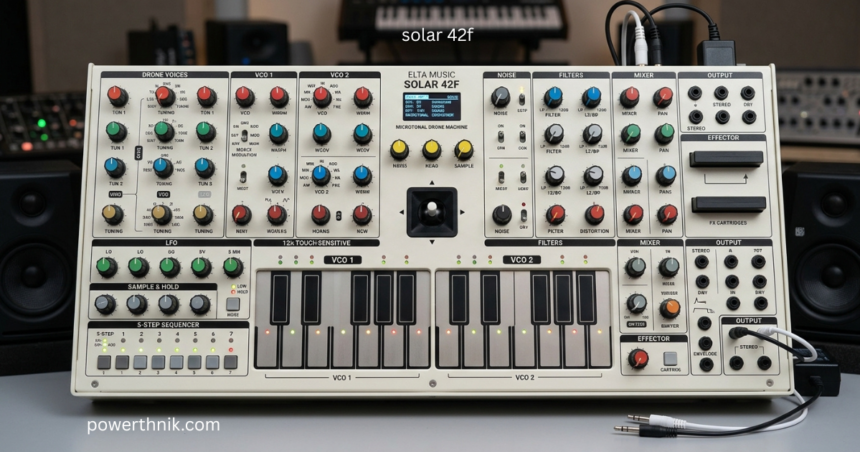
The Solar 42F is an unusual electronic instrument built for musicians who want to move beyond ordinary synthesizer sounds. It combines drones, oscillators, touch control, sequencing, effects, and hands-on routing in one large instrument. Its character suits ambient music, experimental sounds, electronic music, soundtracks, and musicians who enjoy discovering sounds through direct interaction.
For UK musicians, the instrument can work as a creative studio tool rather than a standard replacement for a conventional keyboard. It encourages layered textures, slow sound design, and unusual musical ideas. Its design also reflects the spirit of earlier electronic musical instruments while adding modern control features.
Solar 42F Design and Overall Build
The Solar 42F uses a large flat layout that feels different from a traditional keyboard synthesizer. Its all-metal construction gives it a sturdy feel, while the black, yellow, cream, and pink details make it visually distinctive.
The layout matches its drone synth character. Instead of hiding the sound engine behind menus, the instrument puts much of its creative palette directly in front of the player. This setup encourages experimentation and makes small changes in tone easy to hear.
Solar 42F Synth Architecture and Oscillators
The Solar 42F has a complex synth architecture with six drone voices. Four voices follow the approach of the Solar 50 and use five sawtooth oscillators that can be tuned independently. You can mute voices, create harmonics, build dissonance, or combine pitches into rough chords.
The other two drone voices take a stranger route. Their ideas draw from DIY noise synths and Papa Srapa, producing sounds that can suggest bird cries, space monsters, gusts of wind, or mechanical noise.
Drone Voices and Tuning
Drone sounds form a major part of its experience. The drone oscillators can create long tones that change as you adjust voltage, tuning, filters, resonance, and effects. Several voices can interact to create wide textures and harmonic tension.
Tuning becomes part of the creative process. The oscillators can experience pitch drift, and their behaviour can change as the synth warms up. That natural drift can add warble and movement to ambient passages. Players who need precise conventional tuning should check the voices before recording.
VCO A and VCO B
VCO A and VCO B provide two more conventional oscillator sections. Their sawtooth waveform can pass through filtering and effects such as delay and reverb. They balance the less predictable drone voices with sounds that feel easier to control.
The two VCO sections can also create a wide stereo image. When tuned and stereo-panned toward the left and right, they can produce a spacious sound.
Filters and Stereo Sound
The filters add another important layer of control. Their cutoff and resonance settings shape brightness, weight, and movement. Lowering the cutoff can soften a harsh drone, while resonance can emphasise part of the sound.
The stereo design makes these changes more noticeable. With independent resonance and linked cutoff controls, you can make a sound feel focused, open, soft, or sharp. This makes the filter section useful for slow ambient changes as well as active electronic performances.
Effects and Cartridges
The effects section expands the sound-design options. Effects chips and cartridges can introduce reverb, filtering, bit crushing, and other colour changes. The instrument supports 13 cartridges, giving players different effect options.
You can explore a reverb algorithm, add noise, change the color of a sound, or combine external processing with the built-in effects. Effects can become part of the sound-generation process instead of simply being added at the end.
Scales and Musical Control
Although the instrument has an experimental identity, its musical controls support structured playing. The scale system lets you work with existing scales or edit them manually. You can use a major scale, chromatic scale, or combinations that emphasize minor notes, a minor 6th, or a minor 7th.
The scale mode can also support unusual harmonic ideas. Choosing a root note and controlling intervals such as the fourth, sixth, or major 7th creates different musical colors. This gives the Solar 42F a bridge between microtonal exploration and conventional composition.
Performance Controls and Sequencing
The touch keyboard gives the Solar 42F a direct performance feel. A joystick controller adds another physical way to change musical or sonic behavior, while the step sequencer can organize repeating patterns.
The split keyboard and two keyboards arrangement also expand performance options. You can manage drones and melodic material together, then use semi-modular CV routing to connect control elements. This kind of patching can change how the synthesizer responds.
Sound, Music Styles and Creative Uses
The Solar 42F works naturally with drones, ambient soundscapes, experimental sounds, and electronic music. It can also support conventional melodic and harmonic writing when you use the VCOs, scales, and sequencer in a controlled way.
For soundtracks, long drones, organic drift, stereo filtering, and effects can create atmosphere without a large collection of separate instruments. A solo performer can treat it as a creative playground, while collaborative musicians can send its sounds into a wider production.
Inspirations Behind the Solar 42F
The Solar 42F connects with the history of early electronic musical instruments. Its spirit reflects experiments from the 1920s and 1950s, when designers explored new ways to create and control sound.
The connection with Leon Theremin, the electric harmonium, and the Solar 50 provides useful context. Hans Zimmer, Benjamin Wallfisch, and the soundtrack of Blade Runner 2049 also offer a modern reference point for listeners interested in atmospheric electronic sound.
Semi-Modular Design
The semi-modular design gives the instrument flexible ways to connect sound and control paths. CV signals and CV routing allow different sections to interact, changing the relationship between controls and the synth engine.
Starting with one connection and listening to the result makes the system easier to understand. As you learn the layout, more complex routing can become part of performance and sound design.
Unique and Experimental Character
What makes the Solar 42F stand out is its willingness to be unusual. It combines drones, ambience, conventional synth performance, experimental sounds, physical controls, sequencing, and effects in one instrument. That mixture gives it a distinctive identity.
The best approach is to treat it as a tool for exploration. Its value comes from having enough control to keep experimenting until an unexpected sound becomes useful.
Songwriting Experiment
A songwriting session can begin with three-note drones. Hold a drone, use the filter and resonance to shape it, then introduce another oscillator at an octave or related interval. A tuned drone can provide the foundation for a chord progression.
Once a useful texture appears, record it and add melodic material around the atmosphere. Reverb can place the parts into a larger sonic space.
Personal Hands-On Exploration
The strongest part of using the Solar 42F may come from spending time with it rather than trying to master every feature immediately. Even one focused hour can reveal how the oscillators, filters, scales, effects, and routing interact.
Instead of starting with a preset, you can begin with a drone, movement, or unusual effect and discover where the sound leads.
Overall Verdict
This instrument is a distinctive experimental option for musicians who enjoy drones, ambience, physical control, and unconventional sound creation. It can support conventional musical ideas, but its strongest character appears when you allow it to behave unpredictably.
If you want a straightforward keyboard synthesizer, its unusual architecture may take time to learn. If you want a creative instrument that rewards experimentation, it brings together drone voices, VCOs, filters, effects, sequencing, scales, and semi-modular control in an engaging way.
FAQs solar 42f
Is the Solar 42F suitable for beginners?
This instrument can suit beginners who enjoy experimentation, but its many sections may feel complex at first. Start with the touch keyboard, basic oscillators, filter, and effects before exploring deeper CV routing.
What type of music works well with the Solar 42F?
Ambient music, electronic productions, experimental sounds, soundtracks, and unconventional compositions fit its character. Its scales and VCOs also support more conventional melodic and harmonic material.
Does the Solar 42F stay perfectly in tune?
The drone oscillators can experience pitch drift, and their behaviour may change as the instrument warms up. This can add organic movement, although precise recording may require careful tuning first.
Can you use this instrument for songwriting?
Yes. You can begin with drone notes, add tuned oscillators, shape the sound with filters and resonance, and then build a chord progression or melody around the result.
What makes the Solar 42F different from a normal synthesizer?
Its combination of drone voices, unusual oscillators, touch control, joystick performance, cartridges, effects, scales, sequencing, and semi-modular CV routing creates a more experimental workflow.
Is the Solar 42F useful for soundtrack production?
Yes. Drones, stereo sound, filters, reverb, pitch movement, and unusual textures can provide atmospheric material for soundtrack-style work.