
If you’re weighing up solar for your roof, you’ve probably typed how many solar panels do I need into Google more than once. The honest answer is that it depends on a handful of things your electricity use, your roof, and where in the UK you live but most homes land in a fairly predictable range.
Most UK households need somewhere between 8 and 13 solar panels, which works out to a 3–4 kW system, to cover a typical annual electricity use of around 2,700 kWh. That’s the headline number.
The rest of this guide walks through why that figure moves up or down, and how to work out how many solar panels you need for your own home.
Factors That Affect the Number of Solar Panels You Need
The number of solar panels you need mainly depends on your household’s electricity use, roof direction and size, and panel wattage. A typical UK home uses around 2,700 kWh per year, while larger households or homes with EVs and heat pumps may use more.
South-facing roofs generally produce the best results, while east- and west-facing roofs can still work well. Panel wattage also matters, as higher-wattage panels can provide the same output with fewer units.
It is best to consider your future energy needs when sizing your system.
How to Work Out How Many Solar Panels You Need Yourself
You don’t need to hire an engineer to get a rough figure. Grab your last 12 months of energy bills (or your last one, if that’s all you have) and find your total kWh used. Divide the yearly total by 365 to get your average daily usage. If you only have one month’s bill, divide that figure by 30 instead.
Next, you need your area’s average sun hours sometimes called peak sun hours or the production ratio. In the UK, the typical production ratio works out to around 3.225 watt-hours per day for every watt of panel capacity, though this varies by region and season. Multiply that by your chosen panel’s wattage to get its daily output: a 350W panel generates roughly 395 Wh a day, while a 450W panel manages closer to 508 Wh.
Finally, divide your daily usage by that daily panel output, and you’ve got your answer to how many solar panels do I need. If your daily usage is, say, 10 kWh and each panel produces roughly 1.3 kWh a day, you’re looking at around 8 panels right in line with the UK average for a typical household.
How Many Panels Does an Average UK Home Need?
Here’s a rough breakdown by home size, based on typical UK electricity consumption, to help answer how many solar panels do I need for a house like mine.
A 1–2 bedroom home using 1,800–2,000 kWh a year usually needs a 2–3 kW system, or 4–8 panels, across roughly 8–16 m² of roof. A 2–3 bedroom home, closer to the national average at 2,700–3,350 kWh, typically needs a 3–4 kW system with 8–10 panels. Step up to a 3–4 bedroom house using around 4,000 kWh, and you’re looking at a 4–5 kW system with 10–13 panels. Larger homes, especially those charging an EV, often need 6–8 kW and 15–20 panels to keep up.
Most homes fall in that 8–13 panel window, but as more households add EVs and heat pumps, larger systems are becoming the norm rather than the exception.
Roof Space, Location and Weather
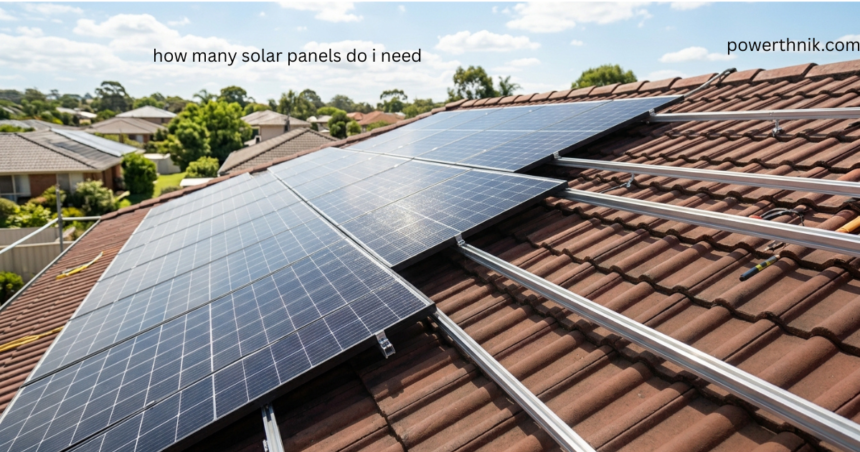
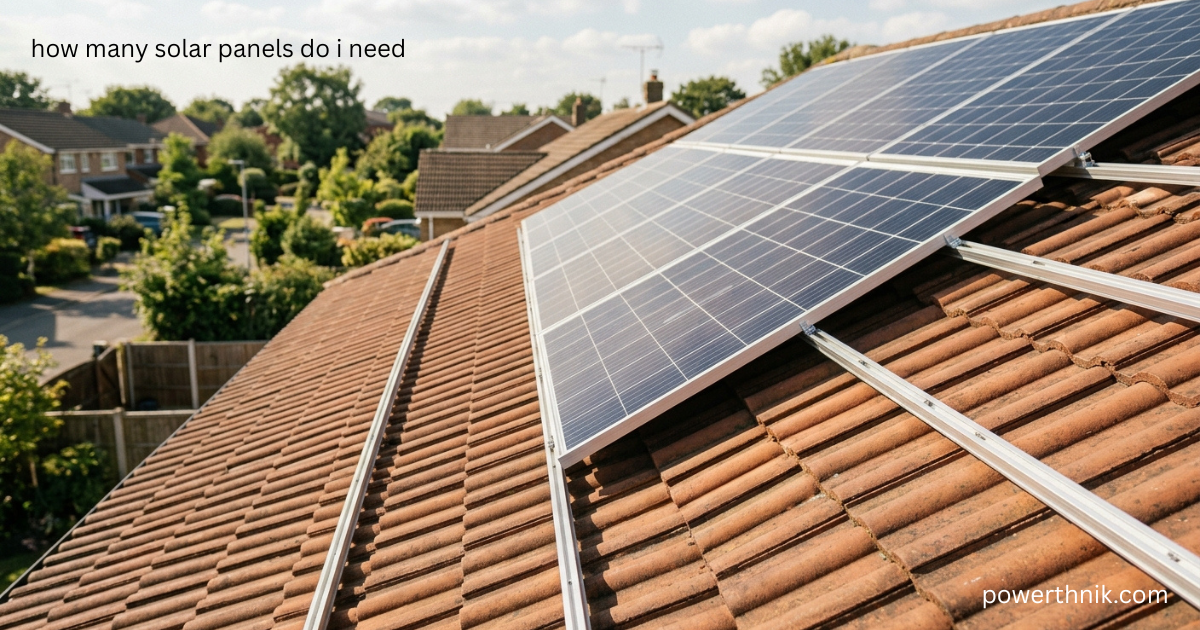
A typical 4 kW system needs about 16–20 m² of clear roof space, with panels spaced roughly 3 cm apart and kept at least 30 cm from the roof edge. Shading from trees, chimneys, or neighboring buildings can quietly cut your output, so it’s worth checking your roof at different times of day before committing to a layout.
Location matters more than people expect. The UK averages around 1,000 kWh/m² of solar irradiance a year, but southern regions consistently outperform northern ones, and winter output drops noticeably compared to summer. Installers usually build in a 10–15% buffer for seasonal variation and apply a performance ratio of 75–85% to account for real-world losses from wiring, inverter conversion, and shading. Even the panels themselves lose a little efficiency as temperatures climb typically 0.3–0.5% per degree above 25°C so cooler, cloudy Britain isn’t quite the disadvantage it might seem.
Planning Permission and Grid Rules
Good news first: there’s no strict legal cap on how many panels you can install. Most UK homes fall under permitted development rights, meaning you won’t need formal planning permission as long as the panels don’t extend beyond the roof slope, stay below the roof’s highest point, and the building is under 15 meters tall. Listed buildings, conservation areas, and World Heritage Sites are the main exceptions, so it’s worth a quick call to your local planning authority if you fall into one of those categories.
Regardless of planning permission, every installation has to meet UK Building Regulations, and using an MCS-accredited installer is the easiest way to make sure that happens. You’ll also need to notify your local Distribution Network Operator (DNO) when connecting to the grid this is standard practice, though systems over 3.68 kW may need extra sign-off before you can switch on.
Costs Worth Factoring In
Solar panels are low-maintenance by design mostly the odd clean and a periodic inspection. That said, a few costs are worth planning for. The panels themselves typically last 25 years or more, but inverters often need replacing after 10–15 years, so budget for that somewhere down the line. If you’re keen to make the most of what your panels generate, adding battery storage lets you bank excess daytime energy for use at night or during a power cut, which noticeably boosts how much of your own solar power you actually use rather than exporting it back to the grid for a lower return.
The Bottom Line
For most UK homes, 8 to 13 panels around a 4 kW system will comfortably cover typical electricity use. If you’re still asking yourself how many solar panels do I need before getting quotes, your own number ultimately comes down to three things: how much power you use, how much usable roof space you’ve got, and which panels you choose. A proper site assessment from an accredited installer is still the best way to get an exact figure, since it accounts for your specific roof, shading, and household needs rather than a UK-wide average. But if you’re just trying to get a ballpark before that call, the numbers above should get you close.
Conclusion
Working out how many solar panels do I need doesn’t have to feel complicated once you break it down into its parts: your electricity usage, your roof’s size and direction, the panel wattage you choose, and where in the UK you live. Most homes end up somewhere between 8 and 13 panels on a 3–4 kW system, but the only way to get an exact figure for your own house is to run your actual numbers or book a proper site assessment. Whether you’re just starting to research how many solar panels do I need or you’re ready to get quotes, knowing this groundwork means you’ll ask installers the right questions and spot a system that’s genuinely sized for your home not just a generic package.
FAQs
How many solar panels do I need for a 3-bedroom house in the UK?
A typical 3-bedroom home uses around 3,350–4,000 kWh a year, which usually calls for a 4–5 kW system, or roughly 10–13 panels, depending on the wattage chosen.
How many solar panels do I need to run my whole house?
To cover 100% of your usage, you’ll need enough panels to match your full annual kWh figure, which for an average UK home means around 8–13 panels on a 3–4 kW system, though homes with EVs or heat pumps often need more.
Do I need planning permission for solar panels in the UK?
Most homes don’t, thanks to permitted development rights, as long as panels stay within the roof slope and the building is under 15 metres tall. Listed buildings and conservation areas are the main exceptions.
How much roof space do I need for solar panels?
Each panel takes up roughly 1.5–2.2 m², so a standard 4 kW system needs about 16–20 m² of clear, unshaded roof space.
Does the direction my roof faces affect how many panels I need?
Yes. South-facing roofs generate the most power, east/west-facing roofs lose around 15% output, and north-facing roofs are the least efficient, often meaning you’d need more panels to hit the same target.
How many solar panels do I need if I have an electric vehicle?
Charging an EV can add around 2,000 kWh a year to your usage, which typically means five or more extra panels on top of your normal household number.
What size solar system does an average UK home need?
Most UK homes need a 3–4 kW system to cover average annual usage of around 2,700 kWh, which works out to roughly 8–10 panels.
Do more solar panels always mean lower energy bills?
Not necessarily. Savings depend on your usage, panel efficiency, shading, and whether you add battery storage more panels help most when your roof space and orientation are actually able to make use of them.